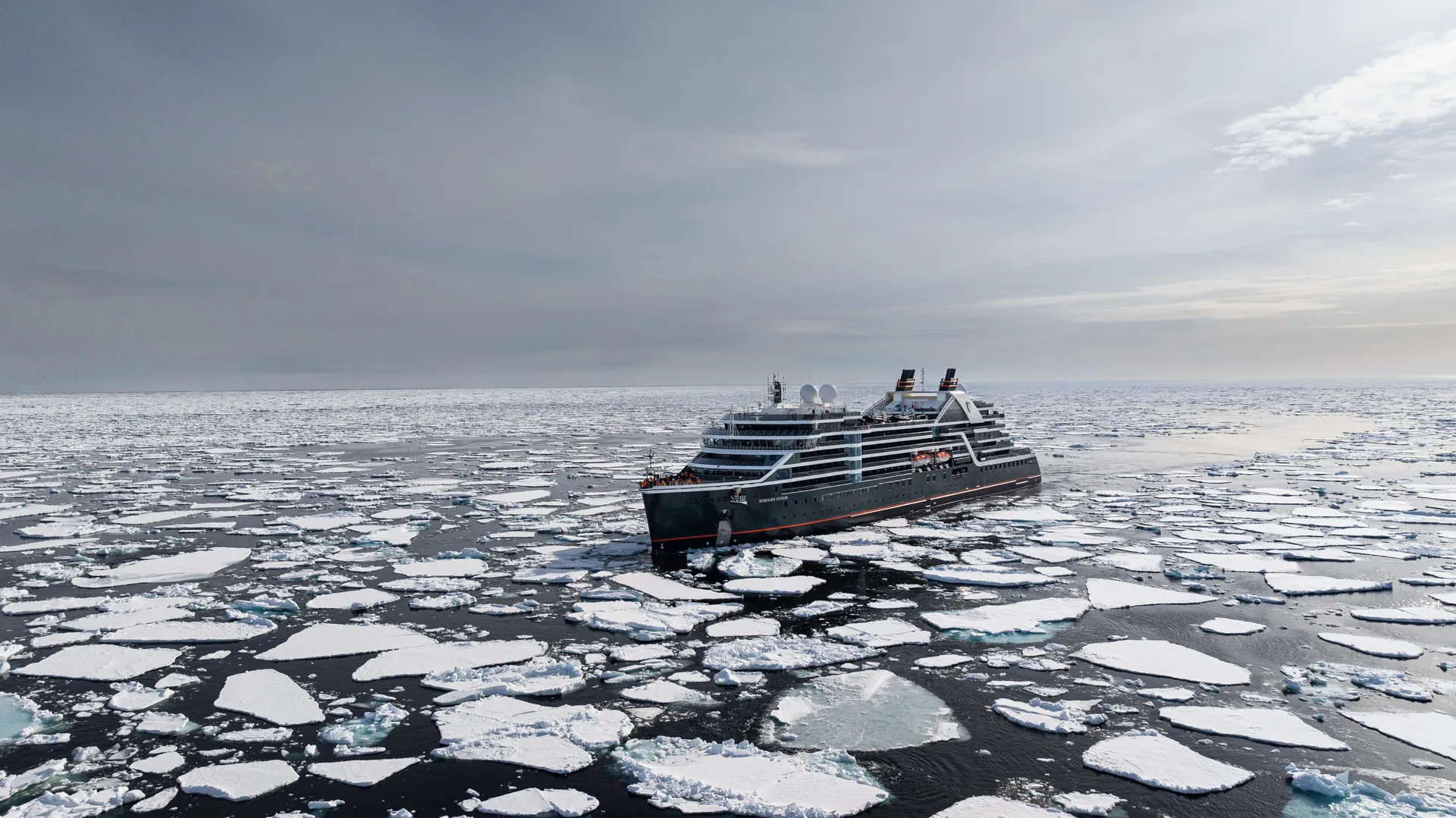
Date
2027-06-07
Duration
40 nights
Departure Port
London (Greenwich)
United Kingdom
Arrival Port
Reykjavik
Iceland
Rating
Expedition
Theme
—



Seabourn
2021
—
23,000 GT
264
132
120
558 m
24 m
19 knots
No

The point from which every navigator on earth determines their longitude, Greenwich anchors the world's meridian with a UNESCO-listed collection of maritime monuments — from the brass Prime Meridian line at the Royal Observatory to the Cutty Sark's wind-worn hull and the baroque Painted Hall of the Old Royal Naval College. Board the Thames Clipper for a 30-minute glide to central London, or explore the weekend market's global food stalls. Summer brings the Thames to its most inviting, with long evenings golden above the river.

Dover stands as Britain's iconic Channel gateway, where towering white chalk cliffs have greeted seafarers for millennia beneath one of England's mightiest medieval castles. Savour the legendary Dover sole at a harbourside table and explore the secret wartime tunnels within the cliffs where the Dunkirk evacuation was orchestrated. Late spring through early autumn offers the finest conditions, with long golden evenings illuminating the chalk face and calm seas for memorable arrivals and departures.

Hakodate, Japan, offers an immersion in a culture where aesthetic refinement and daily life are inseparable. Essential experiences include exploring local food markets, tasting regional specialties at intimate eateries, and visiting the surrounding temples and gardens. The port is most rewarding May through October, when the climate is at its most welcoming for outdoor exploration. Cruise lines including Hapag-Lloyd Cruises feature this port on their most compelling itineraries. Whether you have a few hours or a full day, the port rewards exploration at every pace and in every direction.

Piraeus, the bustling port city of Athens, is a vibrant blend of ancient history and modern charm, inviting travelers to explore its rich culture. Must-do experiences include savoring traditional Greek dishes at the Varvakeios Agora and embarking on day trips to nearby islands like Symi and Nydri. The best time to visit is during the spring and fall when the weather is pleasant and the tourist crowds are fewer.

Plymouth, on Devon's dramatic coast, launched the Mayflower, defeated the Spanish Armada, and provisioned Cook's Pacific discoveries from its magnificent natural harbor. The Barbican's Elizabethan quarter, Plymouth Hoe's panoramic headland, and England's oldest working gin distillery preserve maritime heritage that wartime bombing could not erase. Ambassador Cruise Line and Azamara bring travelers to a city where Drake's legacy, Devonshire cream teas, and proximity to wild Dartmoor create an English port experience of genuine historical grandeur.
A delightful escape from the hubbub of the modern world, three-and-a-half-mile-long Lundy Island is located where the Atlantic Ocean meets the Bristol Channel. Roads are undisturbed by cars. There's a small village, a Victorian church, even a 13th-century castle. The surrounding waters are home to Great Britain's first marine nature reserve. On this granite outcropping, there are farms and open moorlands. Seals blanket the eastern shore. Owned by Britain's National Trust and maintained by the Landmark Trust, the island evokes a more tranquil time.

Holyhead is Wales's maritime gateway on Holy Island, offering dramatic cliff walks to South Stack Lighthouse with its puffin colonies, plus access to Anglesey's Neolithic burial chambers and Edward I's Beaumaris Castle. Must-do experiences include tasting Halen Môn sea salt and lobster at coastal restaurants, exploring Bryn Celli Ddu's ancient passage tomb, and walking the Victorian breakwater. May through September is best, with summer bringing puffins and the longest days.

Dublin is Europe's most literary capital, home to four Nobel laureates in literature, the extraordinary Book of Kells, and Georgian architecture rivaling any on the continent. Visit May through September via Holland America Line or Windstar for Trinity College's Long Room, the definitive Guinness pint at St. James's Gate, and the spontaneous pub conversations that make this city one of the world's most immediately welcoming.
The Calf of Man is an uninhabited nature reserve off the Isle of Man's southern tip, home to significant breeding colonies of Manx shearwaters, puffins, and grey seals in the nutrient-rich tidal streams of the Irish Sea. Must-do experiences include witnessing the eerie dusk chorus of returning shearwaters, observing grey seal colonies, and scanning for basking sharks in the surrounding waters. May and June offer peak seabird activity, while September through November brings the grey seal pupping season.

Douglas is the capital of the Isle of Man, home to the world's oldest parliament (Tynwald), the legendary Tourist Trophy motorcycle races, and a Victorian promenade served by horse-drawn trams since 1876. Visit May through September via Azamara or Windstar for TT race excitement and the cultural distinctiveness of a self-governing island.

Portrush in United Kingdom blends maritime heritage, dramatic coastal scenery, and the understated warmth of the British Isles into a deeply rewarding port of call. Essential experiences include walking the coastal paths and sampling the region's thriving artisanal food scene. The most reliable conditions arrive June through September, when long northern days and mild temperatures make exploration a pleasure, though the atmosphere is compelling in any weather. Cruise lines including Ponant feature this port on their most compelling itineraries. Whether you have a few hours or a full day, the port rewards exploration at every pace and in every direction.

Rathlin Island is Northern Ireland's only inhabited offshore island, home to 150 residents and spectacular RSPB seabird cliffs where puffins, razorbills, and guillemots nest by the thousands. Visitors should watch the seabird colonies from the West Light viewpoint, explore Robert the Bruce's legendary cave, and enjoy a pint at McCuaig's island pub. May through August offers active seabird colonies and wildflower-covered meadows.

Belfast, Northern Ireland’s capital, is a vibrant port city renowned for its rich shipbuilding heritage, highlighted by the Titanic Belfast museum. Must-do experiences include exploring the historic Cathedral Quarter and tasting traditional dishes like Irish stew and soda bread at St. George's Market. The best season to visit is during the spring and summer when the city comes alive with festivals and outdoor events.

Kirkwall, the Norse-founded capital of Scotland's Orkney Islands, is a sandstone harbour town framed by UNESCO-listed Neolithic monuments, a twelfth-century cathedral, and some of Britain's finest coastal landscapes. Visitors should not miss the five-thousand-year-old village of Skara Brae and a tasting of North Ronaldsay seaweed-fed lamb paired with Highland Park whisky. The prime cruising season runs from May through August, when Orkney enjoys up to nineteen hours of daylight and the wild coastal light is at its most luminous.
Fair Isle is a tiny, remote island between Orkney and Shetland, renowned for its legendary bird observatory recording 390-plus species and its distinctive hand-knitted colorwork patterns. Must-dos include birdwatching for rare migrants at the observatory, watching seabird colonies on the western cliffs, and acquiring a genuine Fair Isle knitted garment. Visit April to June or August to October for peak bird migration, with summer offering the warmest weather.

Puerto Vallarta, a picturesque port on Mexico's Pacific coast, is celebrated for its charming cobblestone streets, stunning architecture, and vibrant cultural scene. Must-do experiences include savoring local dishes like tacos al pastor and exploring the lively Malecon. The best time to visit is during the dry season from November to April, when warm weather and clear skies create perfect conditions for beachside relaxation and exploration.

Lerwick, capital of Scotland's Shetland Islands, is a captivating Norse-Scottish harbour town renowned for its seventeenth-century granite waterfront, Viking heritage, and pristine maritime larder of wind-dried reestit mutton and hand-dived scallops. Visitors should explore the lodberries along Commercial Street and the award-winning Shetland Museum at Hay's Dock. The optimal season is late May through August, when near-perpetual daylight — the famous "simmer dim" — bathes the islands in an ethereal golden glow and seabird colonies along the cliffs reach their spectacular peak.
The Isle of Noss is a Shetland nature reserve hosting over 100,000 breeding seabirds on its spectacular 181-meter sandstone cliffs, including 12,000 pairs of gannets, guillemots, puffins, and dive-bombing great skuas. Must-do experiences include Zodiac cruising beneath the Noup of Noss cliff face, watching gannet colonies in action, and exploring Shetland's Viking heritage in Lerwick. June and July offer peak seabird activity and Shetland's magical simmer dim twilight.
A distant outpost of Denmark, the Faroe Islands suddenly appear out of the misty North Atlantic, nearly 200 miles from the nearest landfall. Of the twenty-two islands in the group, seventeen are inhabited, with a population of 17,000 residing in the capital city of Torshavn. Irish monks discovered the islands in the 8th century and became the first settlers, only to be driven out by Viking explorers a century later. The traditions and legends of their Viking forefathers are kept alive in a language so close to old Norse that Faroe Islanders can still read the ancient texts inscribed centuries ago. The name Faroe comes from faereyjar, the Old Norse word meaning "Sheep Islands." With thousands of sheep dotting the hillsides, the name remains apt today. While sheep are important to the economy, the real wealth of the islands comes from the fishing industry. A fleet of over 300 trawlers and line-fishing boats bring in an average annual haul of 245,000 tons of cod and herring. Ultra-modern processing and freezing plants do the job of getting the product to market in the most efficient manner.
Klaksvík, the Faroe Islands' second town, is an authentic North Atlantic fishing community set between dramatic fjords and steep mountains on the island of Borðoy. Must-dos include hiking to the Klakkur summit for archipelago views, visiting the Christianskirkjan's Viking-age font, and tasting fermented ræst kjøt and fresh Faroese salmon. May through August provides the mildest weather and longest daylight for exploring this spectacularly rugged corner of the North Atlantic.

Djúpivogur is an intimate Icelandic fishing village on the eastern coast where thirty-four stone egg sculptures line the harbor, Vatnajökull glacier dominates the horizon, and puffin colonies nest on nearby Papey island. Visit June through August via Seabourn or Viking for reindeer sightings, glacier views, and the quiet eastern Iceland that rewards travelers who venture beyond the Golden Circle.

Cartagena, Colombia, is a UNESCO World Heritage Site celebrated for its stunning colonial architecture, vibrant atmosphere, and rich culinary scene. Must-do experiences include exploring the historic Old Town and savoring local specialties like arepas de huevo and ceviche de camarones. The best time to visit is from December to April, when the weather is warm and dry, perfect for leisurely city explorations and excursions to nearby attractions.
Siglufjörður is the northernmost town on the Icelandic mainland, a small fishing village of some 1,200 people. Founded in 1918, it was in the past the capital of the North Atlantic herring fishing industry. The Síldarminjasafnið Herring Era Museum, one of Iceland's largest seafaring and industrial museums, houses three different areas where one can learn about both the traditional and the modern herring industry. A collection of many historic fishing vessels and artifacts is proudly displayed by the people of Siglufjörður, detailing how herring was salted, processed and collected. The small harbor with its colorful fishing boats and the red-roofed steeple of the Lutheran church dominate the village-scape. The natural beauty of the area includes high mountains that rim the fjord, freshwater lakes, the Hólsá river, black sand beaches, and a wealth of birdlife all around. This northernmost region of Iceland is renowned for some of the largest and most dramatic waterfalls in the country.

Dynjandi is the Westfjords' most spectacular waterfall — a 100-meter bridal-veil cascade above a staircase of six smaller falls in a setting of extraordinary fjord scenery. Visitors should hike the wildflower-lined trail to the base of the main cascade, and explore the surrounding Arnarfjordur region with its traditional fishing villages. July and August offer the most reliable weather, though waterproof gear is essential in any season.

Reykjavik, the world's northernmost capital, distils the entire improbable beauty of Iceland into one compact, creatively charged city. The soaring basalt columns of Hallgrímskirkja dominate a skyline of primary-coloured rooftops, while the Harpa Concert Hall shimmers beside the harbour like a captured aurora. Day trips from the city unlock the Golden Circle's geysers and Geysir hot spring, the black sand beaches of Vík, and the ethereal glacier lagoon at Jökulsárlón. Geothermal pools — from the legendary Blue Lagoon to intimate neighbourhood hot pots — offer warmth year-round. June and July bring the bewitching midnight sun.

Qaqortoq is southern Greenland's largest town, where brightly painted houses climb above a fjord harbour amid open-air stone sculptures and Norse ruins. Must-do experiences include visiting the Hvalsey Norse church ruins, soaking in the Uunartoq hot springs surrounded by icebergs, and tasting Arctic char and musk ox. June through September offers the accessible season, with July and August warmest for fjord exploration.
Hvalsey, Greenland is a distinctive port city where deep cultural heritage meets authentic local atmosphere, featured on itineraries by Ponant. Must-do experiences include exploring the historic quarter to absorb centuries of architectural heritage, and sampling the distinctive northern cuisine that transforms local ingredients into refined dining experiences. The optimal time to visit is June through August, when summer months bring the warmest temperatures and longest days.
The immense scale of the peaks around this village dwarfs anything built there. Still, the tall white steeple of the church juts up with a spirit of endurance and perseverance that matches the character of those who make this arctic outpost their home. It also echoes the shape of icebergs floating in the surrounding seas, shed from the immense icefields that cover much of the island.

Tasermiut Fjord in southern Greenland features granite towers rivaling Patagonia in vertical grandeur, with peaks like Ulamertorsuaq rising 1,500 meters from the water's edge. Must-dos include Zodiac cruising beneath the massive rock walls and exploring Norse settlement ruins in the valley floors. Late June through early September offers the best conditions, with relatively mild temperatures for Greenland.

Manaus is the Amazon's improbable metropolis, a thousand miles inland where the rubber boom's Teatro Amazonas opera house rises above the world's largest rainforest. Must-dos include witnessing the Meeting of the Waters where two rivers flow side by side without mixing, tasting Amazonian cuisine at the Adolpho Lisboa Market, and spotting pink dolphins in the Anavilhanas Archipelago. The wet season (December-May) enables deep forest navigation, while the dry season concentrates wildlife.

Skjoldungen, Greenland is a distinctive port city where deep cultural heritage meets authentic local atmosphere, featured on itineraries by Ponant. Must-do experiences include exploring the historic quarter to absorb centuries of architectural heritage, and sampling the distinctive northern cuisine that transforms local ingredients into refined dining experiences. The optimal time to visit is June through August, when summer months bring the warmest temperatures and longest days.

Tasiilaq is the largest settlement in East Greenland with just 2,000 residents, one of the most remote inhabited communities on Earth, surrounded by the spectacular Sermilik Icefjord, massive glaciers, and tundra that blooms intensely during the brief Arctic summer. Must-dos include a boat trip through the iceberg-filled Sermilik Icefjord, hiking the Valley of Flowers, and watching traditional tupilak carving and drum dancing. Visit August for the warmest weather and best icefjord access.

Flatey Island in Iceland offers dramatic Nordic landscapes where fjords, glaciers, and pristine wilderness create scenes of remarkable natural grandeur. The essential experience is immersion in the outdoor environment—hiking, wildlife watching, and savoring the region's exceptional seafood in settings of extraordinary beauty. Best visited June through August, when the midnight sun bathes the landscape in golden light for nearly twenty-four hours. Cruise lines including Lindblad Expeditions feature this port on their most compelling itineraries. Whether you have a few hours or a full day, the port rewards exploration at every pace and in every direction.
The charming small fishing village of Grundarfjörður is located in the middle of the Snæfellsnes Peninsula and thus provides easy access to Stykkishólmur, Snæfellsbær and the Snæfellsnes National Park. Its best-known landmark is undoubtedly the peak of Mt. Kirkjufell. Translated as ‘church mountain,’ Kirkjufell is the most easily recognizable peak, and one of the most photographed mountains in Iceland. During summer months a Viking Village is built in the center of town where Viking re-enactments occur quite regularly. During the Á góðri stund town festival in July, the town’s 900 residents decorate their houses in red, blue, yellow, and green, transforming the town into a spinning kaleidoscope of color. The town first began trade in 1786, and around 1800, French merchants came to Iceland and settled in Grundarfjörður, where they constructed a church and a hospital. The town has prospered through the fishing industry for a long time. The surrounding sea is rich with birdlife & marine life throughout the year.

Reykjavik, the world's northernmost capital, distils the entire improbable beauty of Iceland into one compact, creatively charged city. The soaring basalt columns of Hallgrímskirkja dominate a skyline of primary-coloured rooftops, while the Harpa Concert Hall shimmers beside the harbour like a captured aurora. Day trips from the city unlock the Golden Circle's geysers and Geysir hot spring, the black sand beaches of Vík, and the ethereal glacier lagoon at Jökulsárlón. Geothermal pools — from the legendary Blue Lagoon to intimate neighbourhood hot pots — offer warmth year-round. June and July bring the bewitching midnight sun.
Day 1

The point from which every navigator on earth determines their longitude, Greenwich anchors the world's meridian with a UNESCO-listed collection of maritime monuments — from the brass Prime Meridian line at the Royal Observatory to the Cutty Sark's wind-worn hull and the baroque Painted Hall of the Old Royal Naval College. Board the Thames Clipper for a 30-minute glide to central London, or explore the weekend market's global food stalls. Summer brings the Thames to its most inviting, with long evenings golden above the river.
Day 2

Dover stands as Britain's iconic Channel gateway, where towering white chalk cliffs have greeted seafarers for millennia beneath one of England's mightiest medieval castles. Savour the legendary Dover sole at a harbourside table and explore the secret wartime tunnels within the cliffs where the Dunkirk evacuation was orchestrated. Late spring through early autumn offers the finest conditions, with long golden evenings illuminating the chalk face and calm seas for memorable arrivals and departures.
Day 3

Hakodate, Japan, offers an immersion in a culture where aesthetic refinement and daily life are inseparable. Essential experiences include exploring local food markets, tasting regional specialties at intimate eateries, and visiting the surrounding temples and gardens. The port is most rewarding May through October, when the climate is at its most welcoming for outdoor exploration. Cruise lines including Hapag-Lloyd Cruises feature this port on their most compelling itineraries. Whether you have a few hours or a full day, the port rewards exploration at every pace and in every direction.
Day 4

Piraeus, the bustling port city of Athens, is a vibrant blend of ancient history and modern charm, inviting travelers to explore its rich culture. Must-do experiences include savoring traditional Greek dishes at the Varvakeios Agora and embarking on day trips to nearby islands like Symi and Nydri. The best time to visit is during the spring and fall when the weather is pleasant and the tourist crowds are fewer.
Day 5

Plymouth, on Devon's dramatic coast, launched the Mayflower, defeated the Spanish Armada, and provisioned Cook's Pacific discoveries from its magnificent natural harbor. The Barbican's Elizabethan quarter, Plymouth Hoe's panoramic headland, and England's oldest working gin distillery preserve maritime heritage that wartime bombing could not erase. Ambassador Cruise Line and Azamara bring travelers to a city where Drake's legacy, Devonshire cream teas, and proximity to wild Dartmoor create an English port experience of genuine historical grandeur.
Day 6
A delightful escape from the hubbub of the modern world, three-and-a-half-mile-long Lundy Island is located where the Atlantic Ocean meets the Bristol Channel. Roads are undisturbed by cars. There's a small village, a Victorian church, even a 13th-century castle. The surrounding waters are home to Great Britain's first marine nature reserve. On this granite outcropping, there are farms and open moorlands. Seals blanket the eastern shore. Owned by Britain's National Trust and maintained by the Landmark Trust, the island evokes a more tranquil time.
Day 7
Day 8

Holyhead is Wales's maritime gateway on Holy Island, offering dramatic cliff walks to South Stack Lighthouse with its puffin colonies, plus access to Anglesey's Neolithic burial chambers and Edward I's Beaumaris Castle. Must-do experiences include tasting Halen Môn sea salt and lobster at coastal restaurants, exploring Bryn Celli Ddu's ancient passage tomb, and walking the Victorian breakwater. May through September is best, with summer bringing puffins and the longest days.
Day 9

Dublin is Europe's most literary capital, home to four Nobel laureates in literature, the extraordinary Book of Kells, and Georgian architecture rivaling any on the continent. Visit May through September via Holland America Line or Windstar for Trinity College's Long Room, the definitive Guinness pint at St. James's Gate, and the spontaneous pub conversations that make this city one of the world's most immediately welcoming.
Day 10
The Calf of Man is an uninhabited nature reserve off the Isle of Man's southern tip, home to significant breeding colonies of Manx shearwaters, puffins, and grey seals in the nutrient-rich tidal streams of the Irish Sea. Must-do experiences include witnessing the eerie dusk chorus of returning shearwaters, observing grey seal colonies, and scanning for basking sharks in the surrounding waters. May and June offer peak seabird activity, while September through November brings the grey seal pupping season.

Douglas is the capital of the Isle of Man, home to the world's oldest parliament (Tynwald), the legendary Tourist Trophy motorcycle races, and a Victorian promenade served by horse-drawn trams since 1876. Visit May through September via Azamara or Windstar for TT race excitement and the cultural distinctiveness of a self-governing island.
Day 11

Portrush in United Kingdom blends maritime heritage, dramatic coastal scenery, and the understated warmth of the British Isles into a deeply rewarding port of call. Essential experiences include walking the coastal paths and sampling the region's thriving artisanal food scene. The most reliable conditions arrive June through September, when long northern days and mild temperatures make exploration a pleasure, though the atmosphere is compelling in any weather. Cruise lines including Ponant feature this port on their most compelling itineraries. Whether you have a few hours or a full day, the port rewards exploration at every pace and in every direction.
Day 12

Rathlin Island is Northern Ireland's only inhabited offshore island, home to 150 residents and spectacular RSPB seabird cliffs where puffins, razorbills, and guillemots nest by the thousands. Visitors should watch the seabird colonies from the West Light viewpoint, explore Robert the Bruce's legendary cave, and enjoy a pint at McCuaig's island pub. May through August offers active seabird colonies and wildflower-covered meadows.
Day 13

Belfast, Northern Ireland’s capital, is a vibrant port city renowned for its rich shipbuilding heritage, highlighted by the Titanic Belfast museum. Must-do experiences include exploring the historic Cathedral Quarter and tasting traditional dishes like Irish stew and soda bread at St. George's Market. The best season to visit is during the spring and summer when the city comes alive with festivals and outdoor events.
Day 14
Day 15

Kirkwall, the Norse-founded capital of Scotland's Orkney Islands, is a sandstone harbour town framed by UNESCO-listed Neolithic monuments, a twelfth-century cathedral, and some of Britain's finest coastal landscapes. Visitors should not miss the five-thousand-year-old village of Skara Brae and a tasting of North Ronaldsay seaweed-fed lamb paired with Highland Park whisky. The prime cruising season runs from May through August, when Orkney enjoys up to nineteen hours of daylight and the wild coastal light is at its most luminous.
Day 16
Fair Isle is a tiny, remote island between Orkney and Shetland, renowned for its legendary bird observatory recording 390-plus species and its distinctive hand-knitted colorwork patterns. Must-dos include birdwatching for rare migrants at the observatory, watching seabird colonies on the western cliffs, and acquiring a genuine Fair Isle knitted garment. Visit April to June or August to October for peak bird migration, with summer offering the warmest weather.

Puerto Vallarta, a picturesque port on Mexico's Pacific coast, is celebrated for its charming cobblestone streets, stunning architecture, and vibrant cultural scene. Must-do experiences include savoring local dishes like tacos al pastor and exploring the lively Malecon. The best time to visit is during the dry season from November to April, when warm weather and clear skies create perfect conditions for beachside relaxation and exploration.

Lerwick, capital of Scotland's Shetland Islands, is a captivating Norse-Scottish harbour town renowned for its seventeenth-century granite waterfront, Viking heritage, and pristine maritime larder of wind-dried reestit mutton and hand-dived scallops. Visitors should explore the lodberries along Commercial Street and the award-winning Shetland Museum at Hay's Dock. The optimal season is late May through August, when near-perpetual daylight — the famous "simmer dim" — bathes the islands in an ethereal golden glow and seabird colonies along the cliffs reach their spectacular peak.
Day 18
The Isle of Noss is a Shetland nature reserve hosting over 100,000 breeding seabirds on its spectacular 181-meter sandstone cliffs, including 12,000 pairs of gannets, guillemots, puffins, and dive-bombing great skuas. Must-do experiences include Zodiac cruising beneath the Noup of Noss cliff face, watching gannet colonies in action, and exploring Shetland's Viking heritage in Lerwick. June and July offer peak seabird activity and Shetland's magical simmer dim twilight.
Day 19
Day 20
A distant outpost of Denmark, the Faroe Islands suddenly appear out of the misty North Atlantic, nearly 200 miles from the nearest landfall. Of the twenty-two islands in the group, seventeen are inhabited, with a population of 17,000 residing in the capital city of Torshavn. Irish monks discovered the islands in the 8th century and became the first settlers, only to be driven out by Viking explorers a century later. The traditions and legends of their Viking forefathers are kept alive in a language so close to old Norse that Faroe Islanders can still read the ancient texts inscribed centuries ago. The name Faroe comes from faereyjar, the Old Norse word meaning "Sheep Islands." With thousands of sheep dotting the hillsides, the name remains apt today. While sheep are important to the economy, the real wealth of the islands comes from the fishing industry. A fleet of over 300 trawlers and line-fishing boats bring in an average annual haul of 245,000 tons of cod and herring. Ultra-modern processing and freezing plants do the job of getting the product to market in the most efficient manner.
Day 21
Klaksvík, the Faroe Islands' second town, is an authentic North Atlantic fishing community set between dramatic fjords and steep mountains on the island of Borðoy. Must-dos include hiking to the Klakkur summit for archipelago views, visiting the Christianskirkjan's Viking-age font, and tasting fermented ræst kjøt and fresh Faroese salmon. May through August provides the mildest weather and longest daylight for exploring this spectacularly rugged corner of the North Atlantic.
Day 22
Day 23

Djúpivogur is an intimate Icelandic fishing village on the eastern coast where thirty-four stone egg sculptures line the harbor, Vatnajökull glacier dominates the horizon, and puffin colonies nest on nearby Papey island. Visit June through August via Seabourn or Viking for reindeer sightings, glacier views, and the quiet eastern Iceland that rewards travelers who venture beyond the Golden Circle.
Day 24

Cartagena, Colombia, is a UNESCO World Heritage Site celebrated for its stunning colonial architecture, vibrant atmosphere, and rich culinary scene. Must-do experiences include exploring the historic Old Town and savoring local specialties like arepas de huevo and ceviche de camarones. The best time to visit is from December to April, when the weather is warm and dry, perfect for leisurely city explorations and excursions to nearby attractions.
Day 25
Siglufjörður is the northernmost town on the Icelandic mainland, a small fishing village of some 1,200 people. Founded in 1918, it was in the past the capital of the North Atlantic herring fishing industry. The Síldarminjasafnið Herring Era Museum, one of Iceland's largest seafaring and industrial museums, houses three different areas where one can learn about both the traditional and the modern herring industry. A collection of many historic fishing vessels and artifacts is proudly displayed by the people of Siglufjörður, detailing how herring was salted, processed and collected. The small harbor with its colorful fishing boats and the red-roofed steeple of the Lutheran church dominate the village-scape. The natural beauty of the area includes high mountains that rim the fjord, freshwater lakes, the Hólsá river, black sand beaches, and a wealth of birdlife all around. This northernmost region of Iceland is renowned for some of the largest and most dramatic waterfalls in the country.
Day 26

Dynjandi is the Westfjords' most spectacular waterfall — a 100-meter bridal-veil cascade above a staircase of six smaller falls in a setting of extraordinary fjord scenery. Visitors should hike the wildflower-lined trail to the base of the main cascade, and explore the surrounding Arnarfjordur region with its traditional fishing villages. July and August offer the most reliable weather, though waterproof gear is essential in any season.
Day 27

Reykjavik, the world's northernmost capital, distils the entire improbable beauty of Iceland into one compact, creatively charged city. The soaring basalt columns of Hallgrímskirkja dominate a skyline of primary-coloured rooftops, while the Harpa Concert Hall shimmers beside the harbour like a captured aurora. Day trips from the city unlock the Golden Circle's geysers and Geysir hot spring, the black sand beaches of Vík, and the ethereal glacier lagoon at Jökulsárlón. Geothermal pools — from the legendary Blue Lagoon to intimate neighbourhood hot pots — offer warmth year-round. June and July bring the bewitching midnight sun.
Day 28
Day 29
Day 30
Day 31

Qaqortoq is southern Greenland's largest town, where brightly painted houses climb above a fjord harbour amid open-air stone sculptures and Norse ruins. Must-do experiences include visiting the Hvalsey Norse church ruins, soaking in the Uunartoq hot springs surrounded by icebergs, and tasting Arctic char and musk ox. June through September offers the accessible season, with July and August warmest for fjord exploration.
Hvalsey, Greenland is a distinctive port city where deep cultural heritage meets authentic local atmosphere, featured on itineraries by Ponant. Must-do experiences include exploring the historic quarter to absorb centuries of architectural heritage, and sampling the distinctive northern cuisine that transforms local ingredients into refined dining experiences. The optimal time to visit is June through August, when summer months bring the warmest temperatures and longest days.
Day 32
Day 33
The immense scale of the peaks around this village dwarfs anything built there. Still, the tall white steeple of the church juts up with a spirit of endurance and perseverance that matches the character of those who make this arctic outpost their home. It also echoes the shape of icebergs floating in the surrounding seas, shed from the immense icefields that cover much of the island.

Tasermiut Fjord in southern Greenland features granite towers rivaling Patagonia in vertical grandeur, with peaks like Ulamertorsuaq rising 1,500 meters from the water's edge. Must-dos include Zodiac cruising beneath the massive rock walls and exploring Norse settlement ruins in the valley floors. Late June through early September offers the best conditions, with relatively mild temperatures for Greenland.
Day 34
Day 35

Manaus is the Amazon's improbable metropolis, a thousand miles inland where the rubber boom's Teatro Amazonas opera house rises above the world's largest rainforest. Must-dos include witnessing the Meeting of the Waters where two rivers flow side by side without mixing, tasting Amazonian cuisine at the Adolpho Lisboa Market, and spotting pink dolphins in the Anavilhanas Archipelago. The wet season (December-May) enables deep forest navigation, while the dry season concentrates wildlife.
Day 36

Skjoldungen, Greenland is a distinctive port city where deep cultural heritage meets authentic local atmosphere, featured on itineraries by Ponant. Must-do experiences include exploring the historic quarter to absorb centuries of architectural heritage, and sampling the distinctive northern cuisine that transforms local ingredients into refined dining experiences. The optimal time to visit is June through August, when summer months bring the warmest temperatures and longest days.
Day 37

Tasiilaq is the largest settlement in East Greenland with just 2,000 residents, one of the most remote inhabited communities on Earth, surrounded by the spectacular Sermilik Icefjord, massive glaciers, and tundra that blooms intensely during the brief Arctic summer. Must-dos include a boat trip through the iceberg-filled Sermilik Icefjord, hiking the Valley of Flowers, and watching traditional tupilak carving and drum dancing. Visit August for the warmest weather and best icefjord access.
Day 38
Day 39
Day 40

Flatey Island in Iceland offers dramatic Nordic landscapes where fjords, glaciers, and pristine wilderness create scenes of remarkable natural grandeur. The essential experience is immersion in the outdoor environment—hiking, wildlife watching, and savoring the region's exceptional seafood in settings of extraordinary beauty. Best visited June through August, when the midnight sun bathes the landscape in golden light for nearly twenty-four hours. Cruise lines including Lindblad Expeditions feature this port on their most compelling itineraries. Whether you have a few hours or a full day, the port rewards exploration at every pace and in every direction.
The charming small fishing village of Grundarfjörður is located in the middle of the Snæfellsnes Peninsula and thus provides easy access to Stykkishólmur, Snæfellsbær and the Snæfellsnes National Park. Its best-known landmark is undoubtedly the peak of Mt. Kirkjufell. Translated as ‘church mountain,’ Kirkjufell is the most easily recognizable peak, and one of the most photographed mountains in Iceland. During summer months a Viking Village is built in the center of town where Viking re-enactments occur quite regularly. During the Á góðri stund town festival in July, the town’s 900 residents decorate their houses in red, blue, yellow, and green, transforming the town into a spinning kaleidoscope of color. The town first began trade in 1786, and around 1800, French merchants came to Iceland and settled in Grundarfjörður, where they constructed a church and a hospital. The town has prospered through the fishing industry for a long time. The surrounding sea is rich with birdlife & marine life throughout the year.
Day 41

Reykjavik, the world's northernmost capital, distils the entire improbable beauty of Iceland into one compact, creatively charged city. The soaring basalt columns of Hallgrímskirkja dominate a skyline of primary-coloured rooftops, while the Harpa Concert Hall shimmers beside the harbour like a captured aurora. Day trips from the city unlock the Golden Circle's geysers and Geysir hot spring, the black sand beaches of Vík, and the ethereal glacier lagoon at Jökulsárlón. Geothermal pools — from the legendary Blue Lagoon to intimate neighbourhood hot pots — offer warmth year-round. June and July bring the bewitching midnight sun.


Deck 7 Combine mid-ship Suites 733 and 735 for Suite 7353, or Suites 734 and 736 for Suite 7364 Total space: 1,399 sq. ft. (130 sq. m.) including two verandas totaling 205 sq. ft. (19 sq. m.)
All Grand Wintergarden Suites onboard Seabourn Venture feature a comfortable living area; private veranda; queen-size bed or two twin beds; walk-in closet; personal safe; interactive TV with music and movies; fully stocked bar and refrigerator; writing desk with personalized stationery; makeup vanity; spacious bathroom, separate tub and shower, plush robes, slippers, luxury health and beauty products, hairdryer and 110/220V AC outlets.


Deck 7 Suites 700, 701 Total space 1,023 sq. ft. (95 sq. m.) incl. veranda of 484 sq. ft. (45 sq. m.)
Owner's Suites on Seabourn Venture feature a comfortable living area; private veranda; queen-size bed or two twin beds; extra-large walk-in closet for expedition gear; personal safe; interactive flat-screen TV with music and movies; fully stocked bar and refrigerator; writing desk with personalized stationery; makeup vanity; spacious bathroom with double vanities, tub and shower, plush robes, slippers, hairdryer and 110/220V AC outlets.


Suites 513-516, 611-614, 711-714, 802-805; Total space: 417 sq. ft. (39 sq. m.) incl. veranda of 85 sq. ft. (8 sq. m.) All Panorama Veranda Suites feature a comfortable living area; private veranda; queen-size bed or two twin beds; walk-in closet; personal safe; interactive TV with music and movies; fully stocked bar and refrigerator; writing desk with personalized stationery; makeup vanity; spacious bathroom, separate tub and shower, plush robes, slippers, luxury health and beauty products, hairdryer and 110/220V AC outlets. *Some veranda sizes vary.


Deck 8 Suites 818-821; Approximate total space: 527 sq. ft. (49 sq. m.) including veranda of 97 sq. ft. (9 sq. m.)
All Penthouse Suites onboard Seabourn Venture feature a comfortable living area; private veranda; queen-size bed or two twin beds; walk-in closet; personal safe; interactive TV with music and movies; fully stocked bar and refrigerator; writing desk with personalized stationery; makeup vanity; spacious bathroom, separate tub and shower, plush robes, slippers, luxury health and beauty products, hairdryer and 110/220V AC outlets.


All Signature Suites onboard Seabourn Venture feature a comfortable living area; private veranda; queen-size bed or two twin beds; walk-in closet, personal safe; interactive TV with music and movies; fully stocked bar and refrigerator; writing desk with personalized stationery; makeup vanity; spacious bathroom, separate tub and shower, plush robes, slippers, luxury health and beauty products, hairdryer and 110/220V AC outlets.


Deck 7 Suites 735, 736; Total space: 1,044 sq. ft. (97 sq. m.) including veranda of 129 sq. ft. (12 sq. m.)
All Wintergarden Suites onboard Seabourn Venture feature a comfortable living area; private veranda; queen-size bed or two twin beds; walk-in closet; personal safe; interactive TV with music and movies; fully stocked bar and refrigerator; writing desk with personalized stationery; makeup vanity; spacious bathroom, separate tub and shower, plush robes, slippers, luxury health and beauty products, hairdryer and 110/220V AC outlets.


Decks 7, 8; Approximate total space: 355 sq. ft. (33 sq. m.) including veranda of 75 sq. ft. (7 sq. m.)*
All Veranda Suites onboard Seabourn Venture feature a comfortable living area; private veranda; queen-size bed or two twin beds; walk-in closet; personal safe; interactive TV with music and movies; fully stocked bar and refrigerator; writing desk with personalized stationery; makeup vanity; spacious bathroom, separate tub and shower, plush robes, slippers, luxury health and beauty products, hairdryer and 110/220V AC outlets. *Some veranda sizes vary.
Our cruise specialists can help you find the perfect cabin and the best available pricing.
(+886) 02-2721-7300Contact Advisor